SriovNetwork
The SriovNetwork resource allows you to create a network for use with an SR-IOV compatible network card. The “SriovNetwork” object is associated with the “SriovNetworkNodePolicy” object. Both entities together provide complete host-level control of SR-IOV network settings.
Please note! To create the SriovNetwork resource, you must have the SriovNetworkNodePolicy resource created. All SR-IOV resources must be installed in the same namespace where SRIOV-Operator is installed. In this case, the kube-system namespace will be applied automatically.
To add a new resource, on the SriovNetworks page of the Networks section, click “+ Add SriovNetwork.” The created resources will be displayed in the list of items.
Screenshot
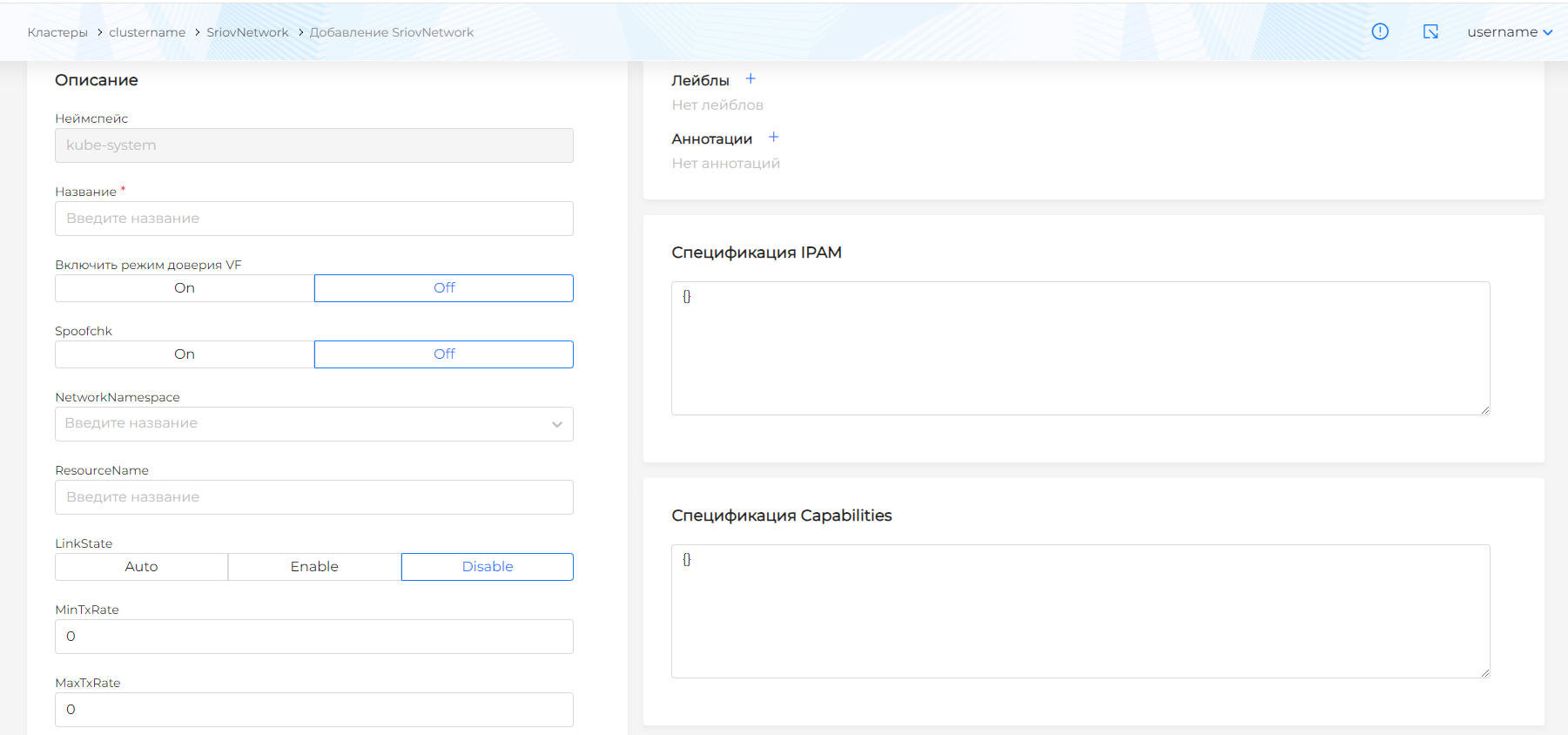
Detailed description of the parameters of the SriovNetwork object
- Title;
- ResourceName: corresponds to the ResourceName of the SriovNetworkNodePolicy network policy;
- IPAM Specification: IP Manager SR-IOV. Defines network parameters, such as subnet and internal IP address range. IPAM is configured in JSON format.
- Specification of capabilities. Configured in JSON format.
- vlan: optional parameter. VLAN ID.
- spoofChk: parameter to enable or disable spoof checking.
- Enable VF trust mode: optional parameter. Indicates whether VF should trust packets containing potentially malicious content. TX speed limit. The maxTxRate and minTxRate fields in the SriovNetwork object indicate the highest and lowest transmission rates (in megabits per second). It is allowed to limit only one of the values:
- maxTxRate: maximum TX speed.
- minTxRate: minimum TX speed.
- linkState: current VF link state. Takes one of the following values:
- auto: The communication state is determined by the network interface driver. This is the default value.
- enable: The network interface (VF) is always enabled, even if the PF is not connected to the network. In this case, outgoing traffic (initialized with VF) will be available, but incoming traffic from PF will not be available.
- disable: VF is always disabled, regardless of the PF state.
- networkNamespace: namespace in which the network will be created.
- vlanQoS: determines the level of service for network traffic within a virtual local area network (VLAN). It is used to configure the priority and processing of network packets on the network interface associated with a VF (Virtual Function).
Accepted values for the vlanQoS field may include:
- 0: “best effort”, where all network packets are treated equally without any preference or priority.
- 1-7: CoS - Class of Service in accordance with the 802.1p standard. They prioritize processing of packets based on their significance or traffic type. For example, a value of 1 may indicate the highest priority, and a value of 7 may indicate the lowest priority.
- -1: Use the default setting or do not explicitly configure VLAN QoS for this VF.
Set labels if necessary.
Read more about SR-IOV technology.
Specification examples
Example IPAM specification in JSON format in a SriovNetwork object
```json { "spec": { "ipam": { "type": "static", "subnet": "10.56.217.0/24", "rangeStart": "10.56.217.171", "rangeEnd": "10.56.217.181", "routes": [ { "dst": "0.0.0.0/0" } ], "gateway": "10.56.217.1" } } } ```Specification description:
IPAM (IP Address Management) is used to manage and allocate IP addresses.
- The “whereabouts” type means dynamic address management. It is a system that manages IP address ranges and assigns them to containers.
- The “static” type in IPAM represents static address management. In this case, IP addresses are assigned statically and can be set manually by the user. When using static IPAM, automatic address assignment and management mechanisms are disabled and all addresses must be manually configured.
Example of a capabilities specification in JSON format in a SriovNetwork object
```json { "mac": true, "ips": true } ```Specification description:
The capabilities set the SR-IOV capabilities. In this examplemacindicates that the SR-IOV interface can have its own MAC address,ipsindicates that the SR-IOV interface can have its own IP address.