SriovNetworkNodePolicy
The SriovNetworkNodePolicy resource allows you to connect containers directly to network equipment. The “SriovNetworkNodePolicy” object is associated with the “SriovNetwork” object. Both entities together provide complete host-level control of SR-IOV network settings.
To add a new resource on the SriovNetworkNodePolicy page of the Networks section, click “+ Add SriovNetworkNodePolicy”. The created resources will appear in the list of items.
All SR-IOV resources must be installed in the same namespace where SRIOV-Operator is installed. In this case, the kube-system namespace will be applied automatically.
Screenshot
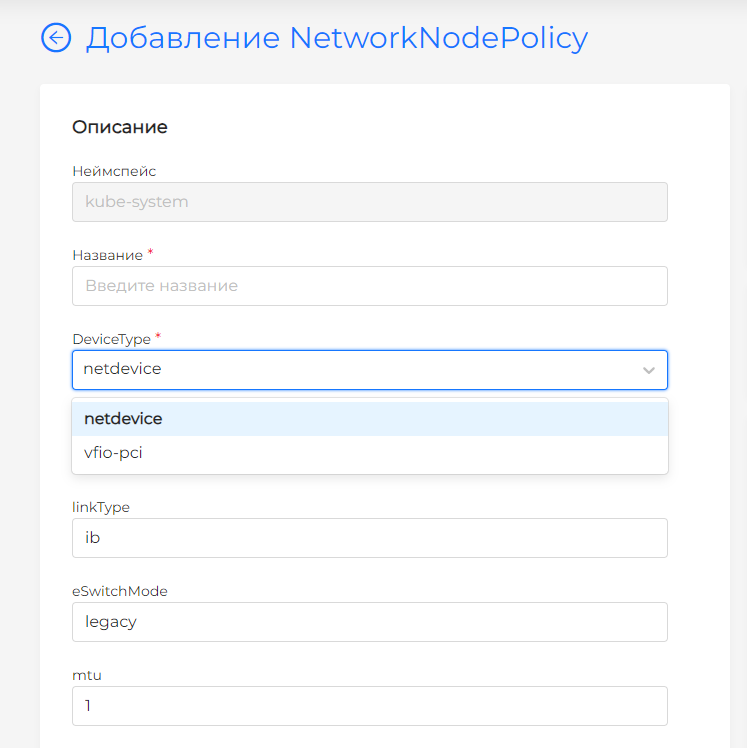
Detailed description of the parameters of the SriovNetworkNodePolicy object
- Title;
- ResourceName: associates the network policy (SriovNetworkNodePolicy) with the network (SriovNetwork);
- Node selector: Determine which nodes are covered by the SR-IOV policy using node labels. Please note! The label selector works on the principle of union. The selected object must have all of the specified labels.
- Priority: priority for applying the SR-IOV policy. If a node has multiple policies, they are applied according to priority.
- deviceTypes: driver type for created VFs. Possible values:
- “netdevice (driver in the Linux kernel)”;
- “vfio-pci” (driver for DPDK).
- mtu: The MTU (Maximum Transmission Unit) value for devices determines the maximum size of a data packet that can be transmitted through the network interface.
- nicSelector: filters for selecting NIC (Network Interface Cards) policies. May include subsets based on Vendor ID, Device ID, Root Device ID, and PfNames.
Screenshot
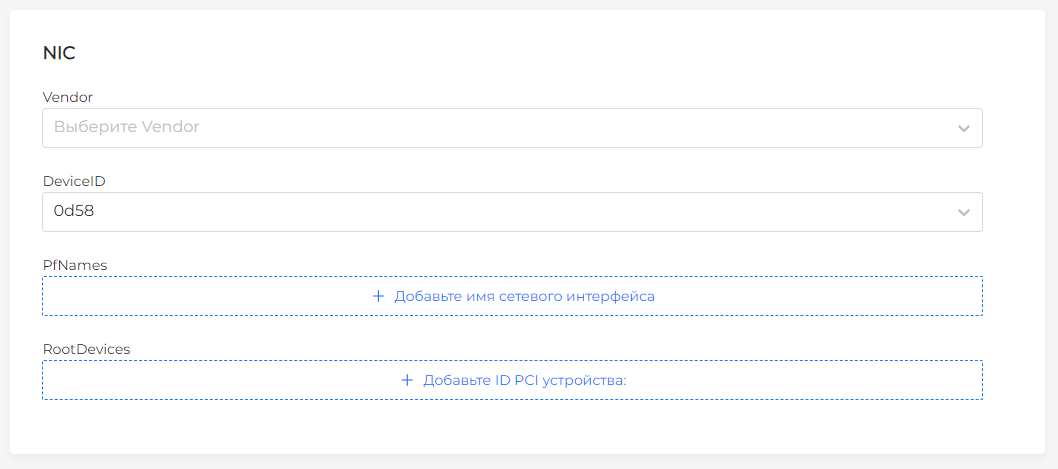
- numVfs: The number of virtual functions that should be configured on each NIC.
- linkType: network connection type. Possible values:
- “Eth”: describes the Ethernet connection;
- “IB”: describes the InfiniBand connection;
- eSwitchMode: operating mode of the virtual switch (eSwitch). Possible values:
- “legacy”: describes the mode of a virtual switch based on a legacy driver;
- “switchdev”: describes a virtual switch mode that offers increased performance and lower latency compared to traditional software switching.
- isRdma: a flag that indicates whether RDMA (Remote Direct Memory Access) is supported.
Specify labels and annotations as needed.