Security policies
In the Security section, pages for managing cluster security policies based on Kyverno are available:
- Security Policy Manager;
- Security policy report.
Security Policy Manager
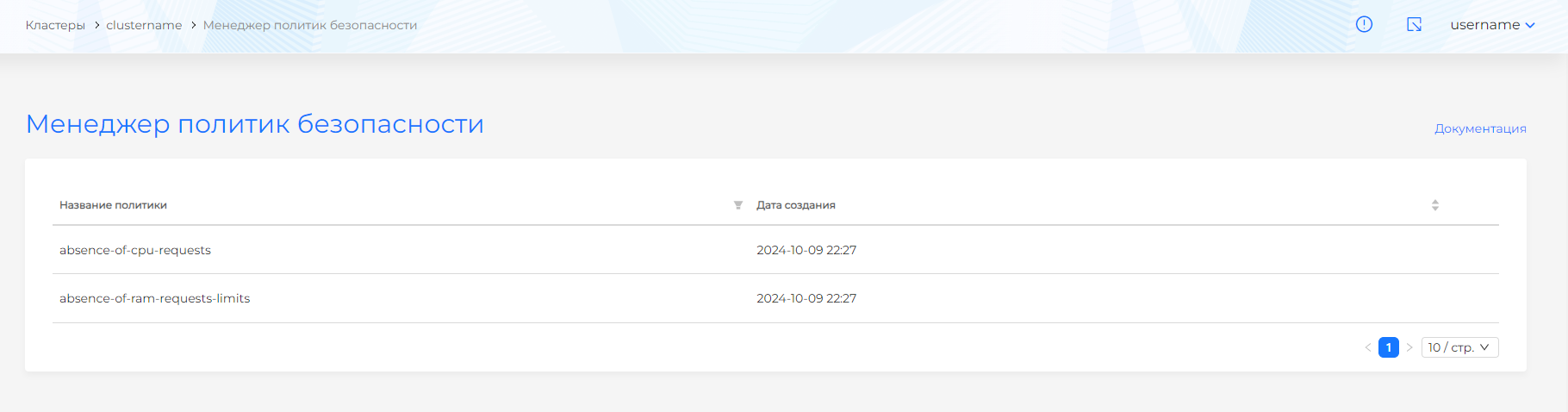
The page is a table listing security policies with the following columns:
- Name (filtering available)
- Creation date (sorting available)
On this page, you can create, view, edit, and delete security policies.
Screenshot
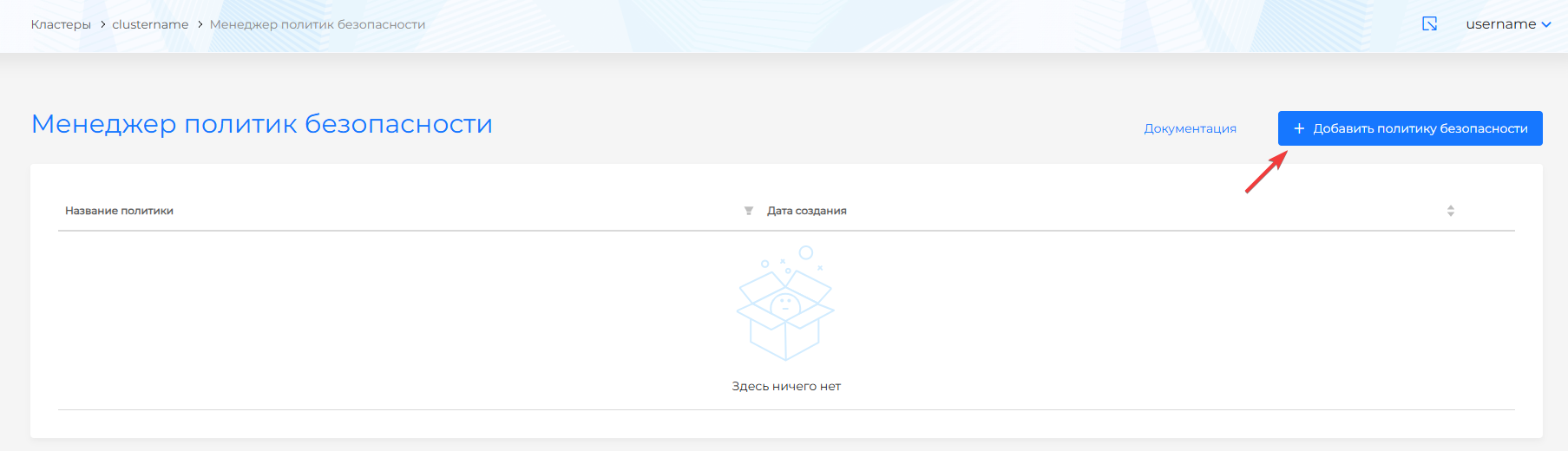
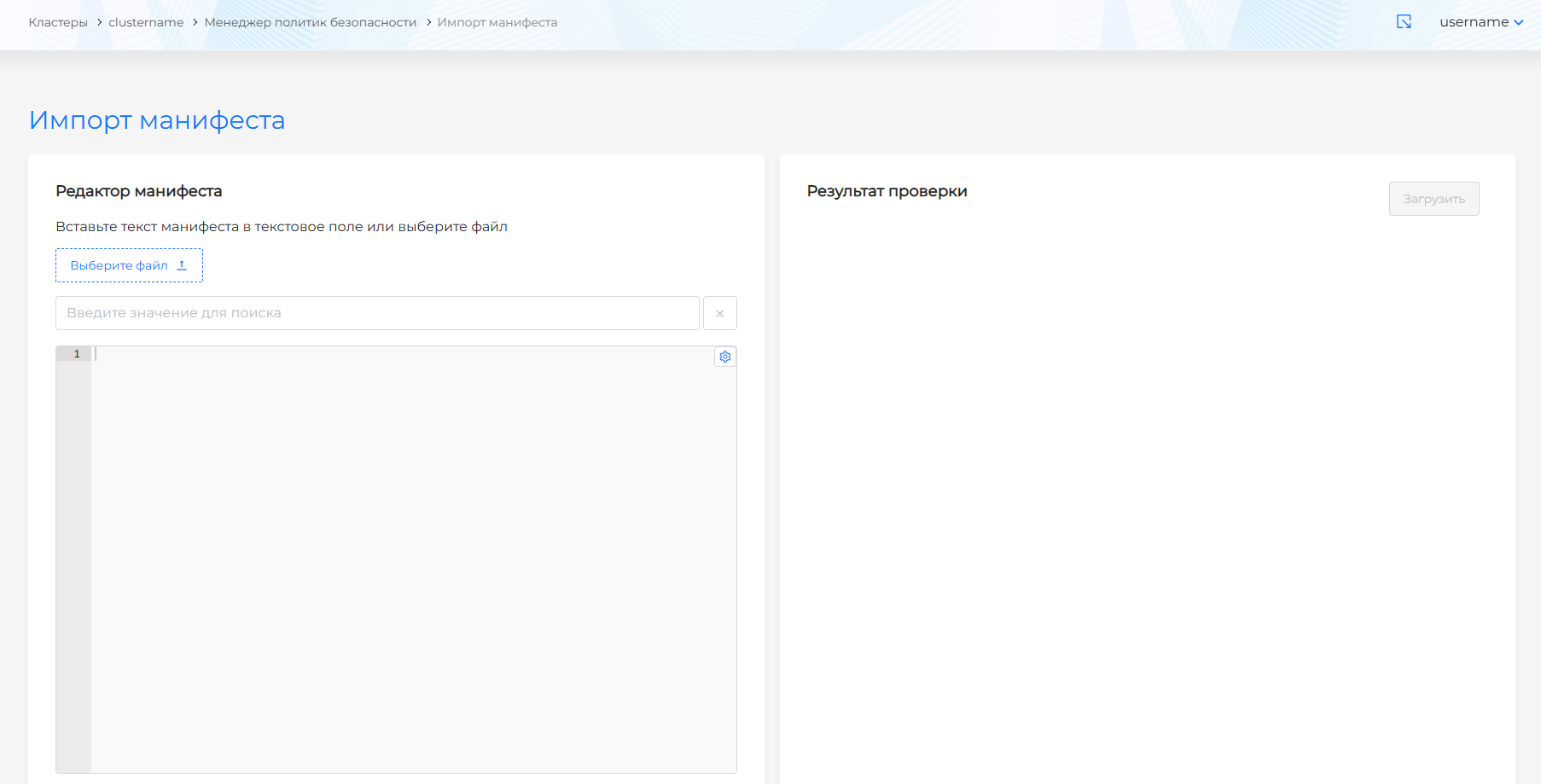
To add a policy, use manifest import. Click + Add security policy.
Screenshot
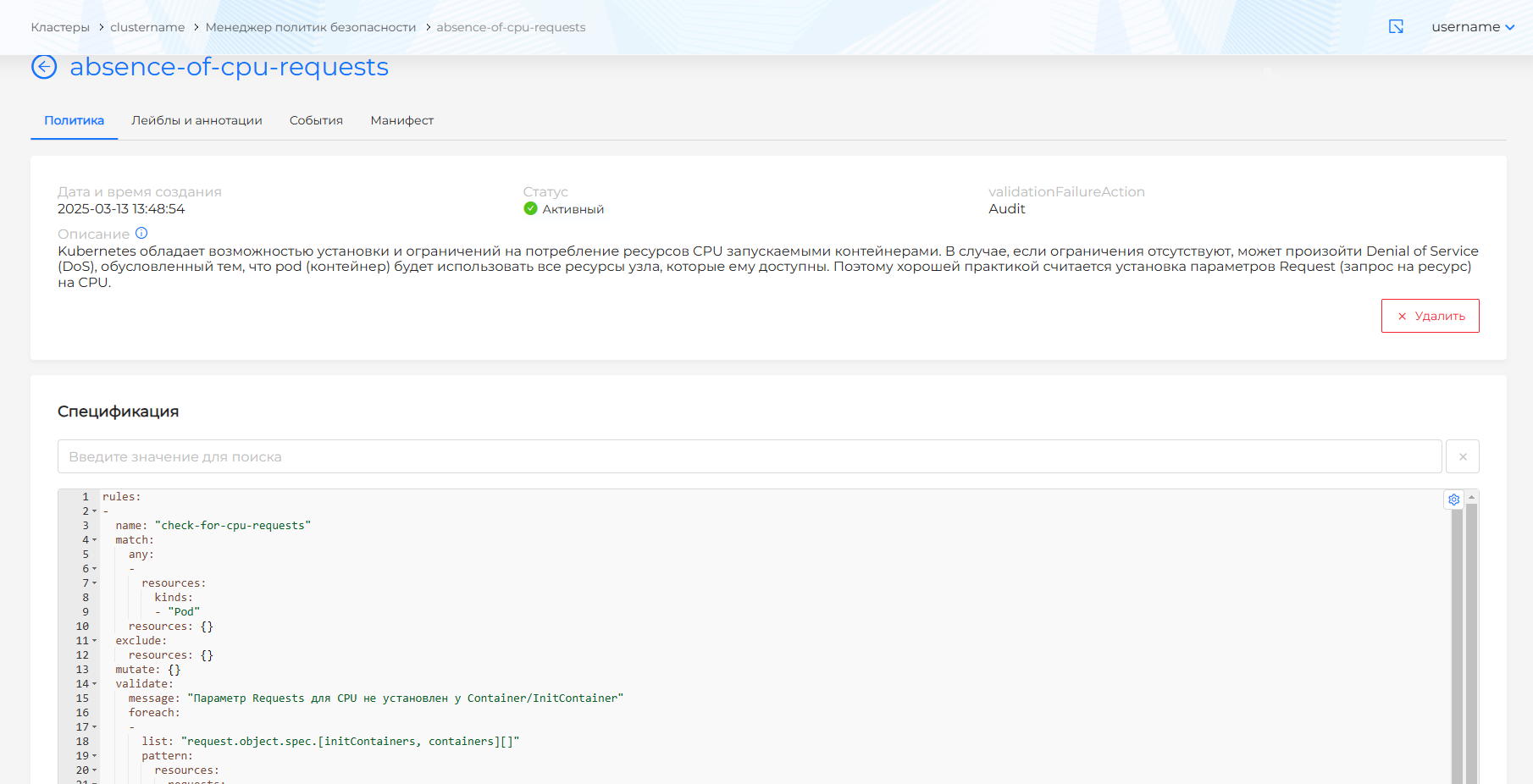
The policy view page has four tabs: policy, labels and annotations, events, and manifest.
Screenshot
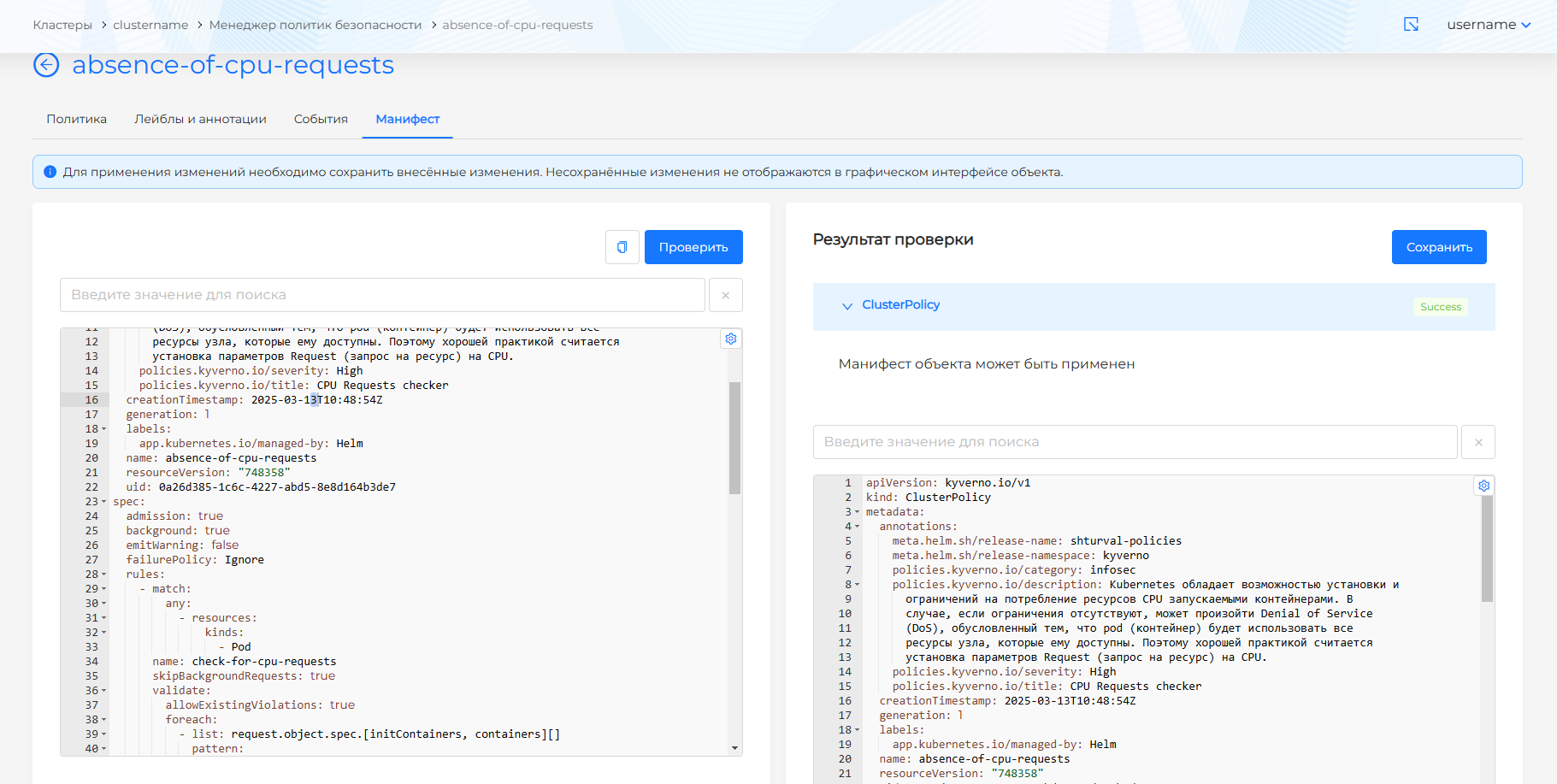
You can edit a security policy using a YAML manifest. Go to the Manifest tab and make changes. After editing the manifest, click Verify. The verification result appears on the right side of the screen. Expand the verification result block to view the full manifest.
Screenshot
For more information about policies, see the official Kyverno website.
Security policy report
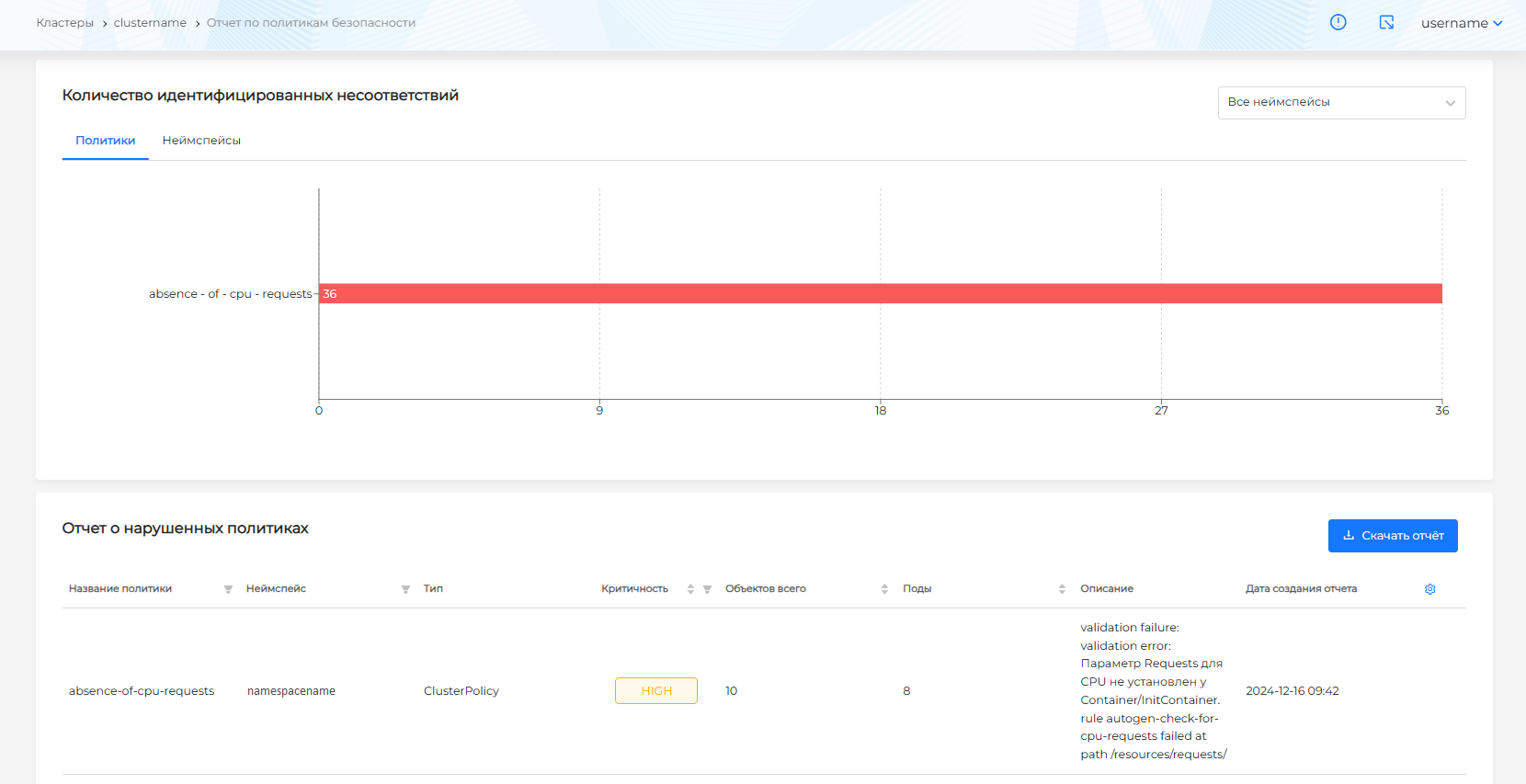
The page shows security policy analysis results. You can view results:
- by policy;
Screenshot
- by namespace.
Screenshot
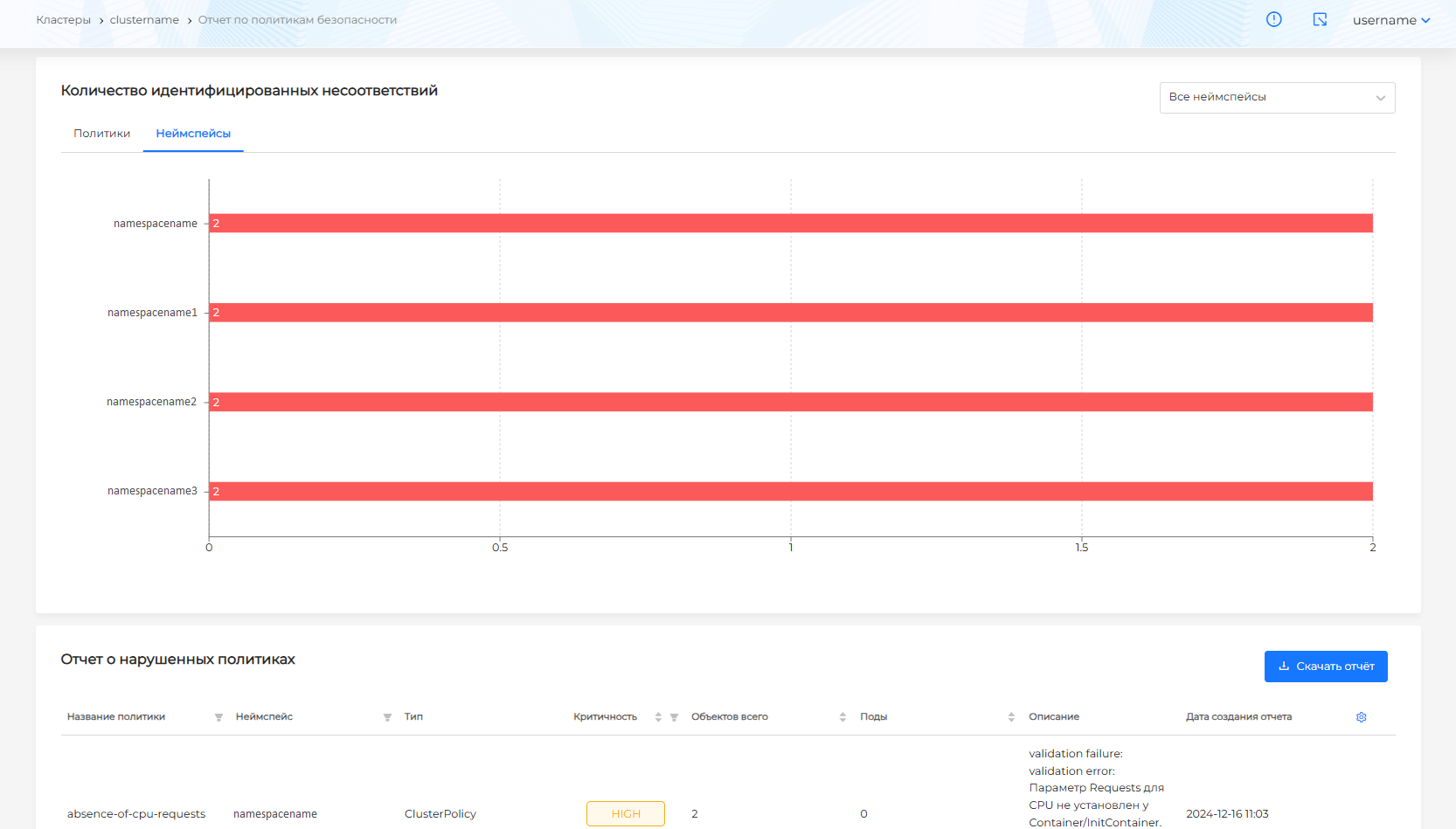
The security policy report also supports filtering by system or user namespaces. By default, the report shows all namespaces. To filter namespaces, select the required filter from the drop-down list in the upper-right corner.
Screenshot

Exporting the report
You can download the report in CSV or PDF format.
MS Excel 2019 and later
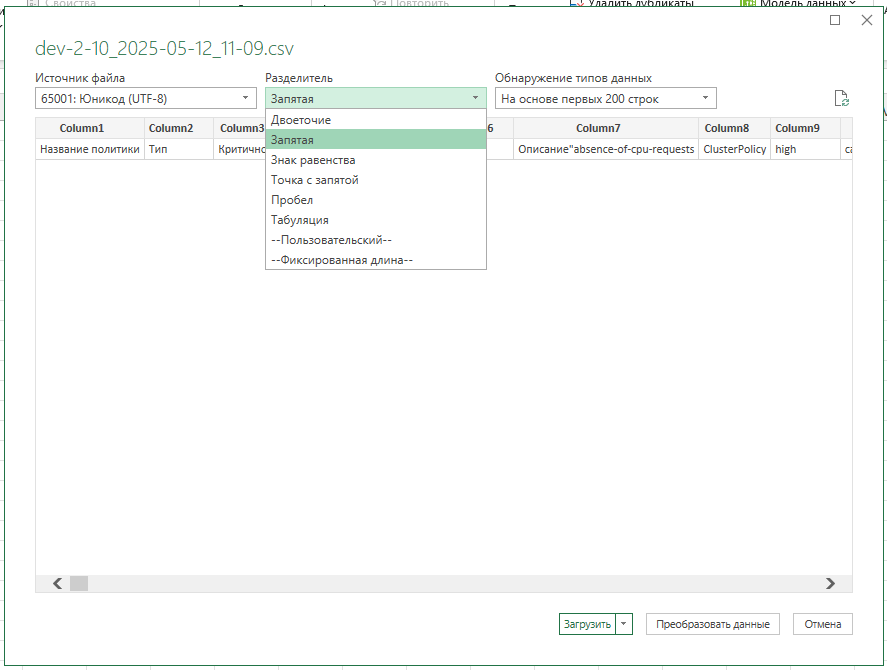
To import a CSV report into MS Excel 2019 and later:
- Create a new MS Excel file and go to the Data section.
Screenshot

Screenshot

Screenshot
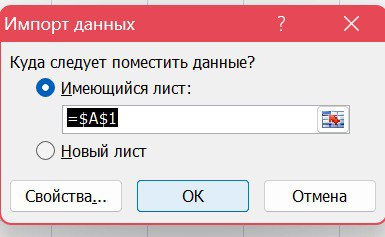
MS Excel 2018 and earlier
To import a CSV report into MS Excel 2018 and earlier:
- Create a new MS Excel file and go to the Data section.
Screenshot

Screenshot
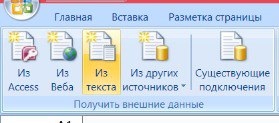
Screenshot
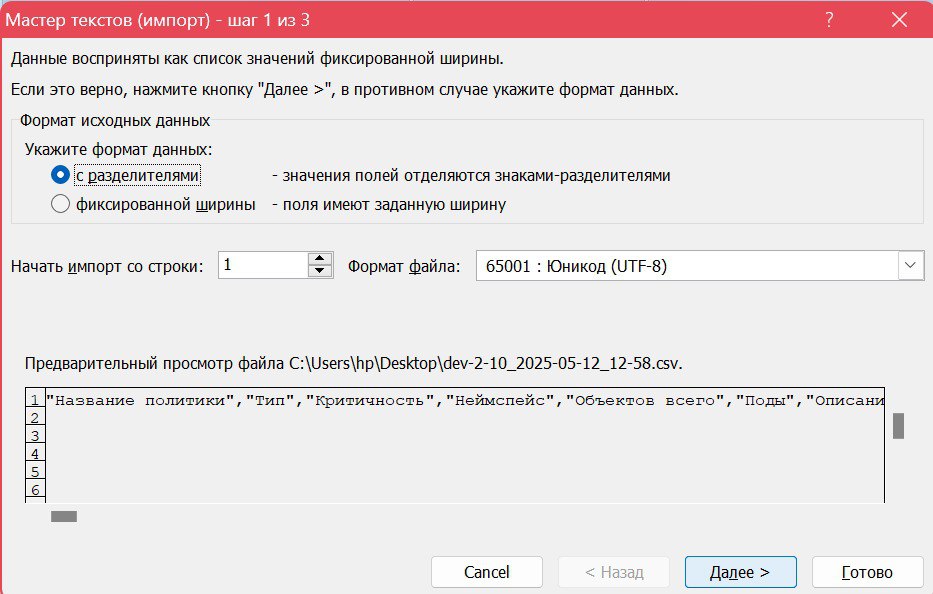
Screenshot
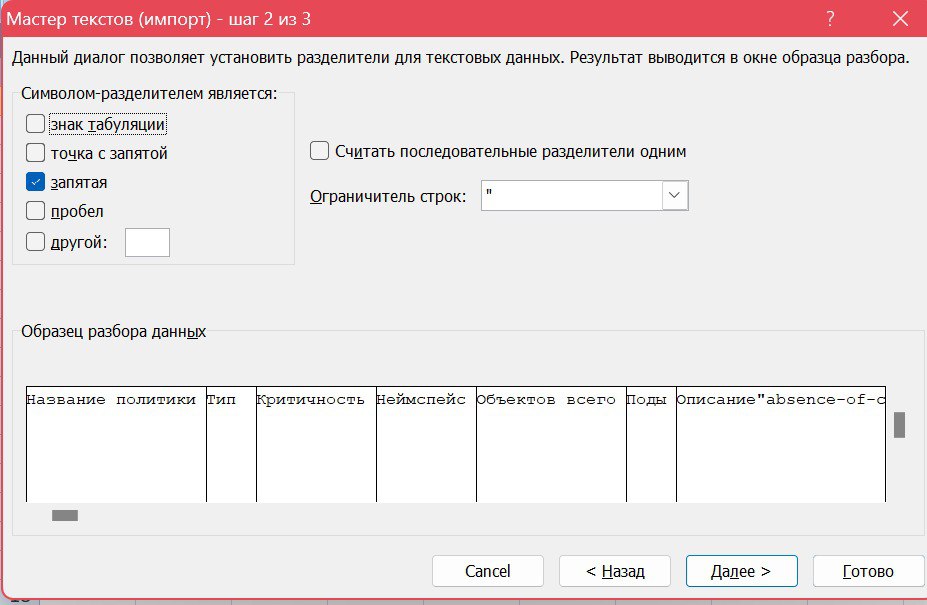
Screenshot
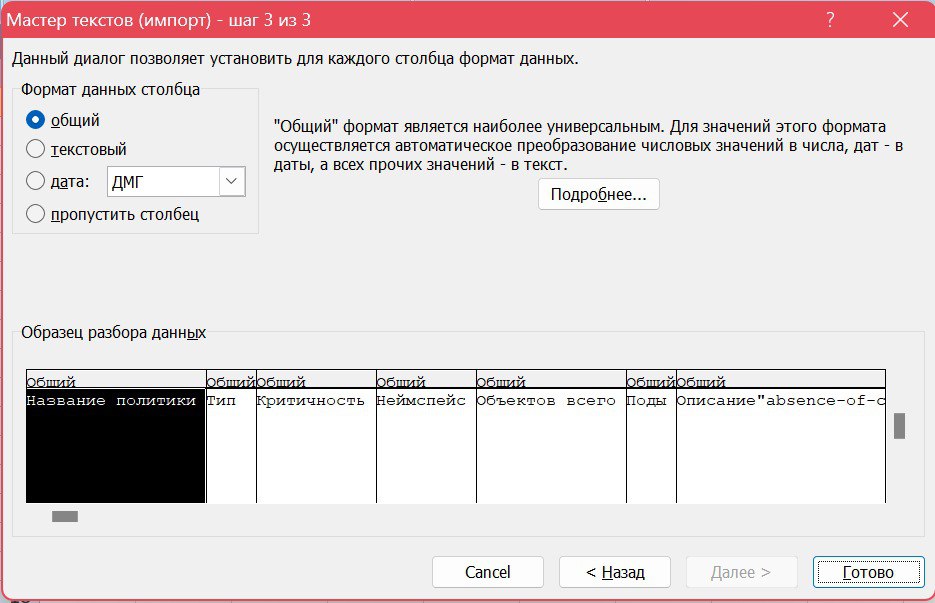
Screenshot
Recommended policies
To add a policy, go to the manifest import interface, paste the required policies, and click Verify. After successful verification, click Upload.
absence-of-cpu-requests
apiVersion: kyverno.io/v1
kind: ClusterPolicy
metadata:
  annotations:
    meta.helm.sh/release-name: shturval-policies
    meta.helm.sh/release-namespace: kyverno
    policies.kyverno.io/category: infosec
    policies.kyverno.io/description: Kubernetes can set and limit CPU consumption
      for running containers. If limits are missing, Denial of Service (DoS) may occur
      because a pod (container) can use all node resources available to it. Therefore,
      setting CPU resource requests is considered a best practice.
    policies.kyverno.io/severity: High
    policies.kyverno.io/title: CPU Requests checker
  labels:
    app.kubernetes.io/managed-by: Helm
  name: absence-of-cpu-requests
spec:
  admission: true
  background: true
  failurePolicy: Ignore
  rules:
  - match:
      any:
      - resources:
          kinds:
          - Pod
    name: check-for-cpu-requests
    skipBackgroundRequests: true
    validate:
      foreach:
      - list: request.object.spec.[initContainers, containers][]
        pattern:
          resources:
            requests:
              cpu: ?*
      message: CPU requests are not set for Container/InitContainer
  schemaValidation: true
  validationFailureAction: Audit
  webhookTimeoutSeconds: 10
absence-of-ram-requests-limits
apiVersion: kyverno.io/v1
kind: ClusterPolicy
metadata:
  annotations:
    meta.helm.sh/release-name: shturval-policies
    meta.helm.sh/release-namespace: kyverno
    policies.kyverno.io/category: infosec
    policies.kyverno.io/description: Kubernetes can limit RAM consumption for running
      containers. If these parameters are not set, Denial of Service (DoS) may occur
      because a pod (container) can use all node resources available to it. Therefore,
      setting RAM resource requests and limits is considered a best practice.
    policies.kyverno.io/severity: High
    policies.kyverno.io/title: RAM Requests and Limits checker
  generation: 1
  labels:
    app.kubernetes.io/managed-by: Helm
  name: absence-of-ram-requests-limits
spec:
  admission: true
  background: true
  failurePolicy: Ignore
  rules:
  - match:
      any:
      - resources:
          kinds:
          - Pod
    name: check-for-ram-requests
    skipBackgroundRequests: true
    validate:
      foreach:
      - list: request.object.spec.[initContainers, containers][]
        pattern:
          resources:
            requests:
              memory: ?*
      message: RAM requests are not set for Container/InitContainer
  - match:
      any:
      - resources:
          kinds:
          - Pod
    name: check-for-ram-limits
    skipBackgroundRequests: true
    validate:
      foreach:
      - list: request.object.spec.[initContainers, containers][]
        pattern:
          resources:
            limits:
              memory: ?*
      message: RAM limits are not set for Container/InitContainer
  schemaValidation: true
  validationFailureAction: Audit
  webhookTimeoutSeconds: 10
automated-satoken-mount-used
apiVersion: kyverno.io/v1
kind: ClusterPolicy
metadata:
  annotations:
    meta.helm.sh/release-name: shturval-policies
    meta.helm.sh/release-namespace: kyverno
    policies.kyverno.io/category: infosec
    policies.kyverno.io/description: 'By default, Kubernetes mounts a ServiceAccount
      token into pods. This token can be used to interact with the API server, which
      most pods do not require. It is recommended to disable this behavior and enable
      it only where truly needed.   '
    policies.kyverno.io/severity: High
    policies.kyverno.io/title: automountServiceAccountToken is set to true
  generation: 1
  labels:
    app.kubernetes.io/managed-by: Helm
  name: automated-satoken-mount-used
spec:
  admission: true
  background: true
  failurePolicy: Ignore
  rules:
  - match:
      any:
      - resources:
          kinds:
          - Pod
    name: check-for-automount-serviceaccount-token
    skipBackgroundRequests: true
    validate:
      message: Automatic ServiceAccount token mounting is enabled in Pod
      pattern:
        spec:
          automountServiceAccountToken: "false"
  schemaValidation: true
  validationFailureAction: Audit
  webhookTimeoutSeconds: 10
container-is-privileged
apiVersion: kyverno.io/v1
kind: ClusterPolicy
metadata:
  annotations:
    meta.helm.sh/release-name: shturval-policies
    meta.helm.sh/release-namespace: kyverno
    policies.kyverno.io/category: infosec
    policies.kyverno.io/description: 'This flag runs a container in privileged mode,
      which an attacker can abuse. For example, to escalate privileges and expand an
      attack against the cluster. Most containers do not require this flag, so it is
      recommended not to use it.   '
    policies.kyverno.io/severity: High
    policies.kyverno.io/title: privileged flag in spec.containers is set to true
  generation: 1
  labels:
    app.kubernetes.io/managed-by: Helm
  name: container-is-privileged
spec:
  admission: true
  background: true
  failurePolicy: Ignore
  rules:
  - match:
      any:
      - resources:
          kinds:
          - Pod
    name: check-for-privileged
    skipBackgroundRequests: true
    validate:
      message: Container with privileged flag detected
      pattern:
        spec:
          containers:
          - =(securityContext):
              =(privileged): "false"
  schemaValidation: true
  validationFailureAction: Audit
  webhookTimeoutSeconds: 10
default-ns-is-used
apiVersion: kyverno.io/v1
kind: ClusterPolicy
metadata:
  annotations:
    meta.helm.sh/release-name: shturval-policies
    meta.helm.sh/release-namespace: kyverno
    pod-policies.kyverno.io/autogen-controllers: none
    policies.kyverno.io/category: infosec
    policies.kyverno.io/description: 'Using the namespace named "default" is not
      recommended. It is considered best practice to use dedicated namespaces for
      teams and/or applications.   '
    policies.kyverno.io/severity: High
    policies.kyverno.io/title: deployment to default namespace
  generation: 1
  labels:
    app.kubernetes.io/managed-by: Helm
  name: default-ns-is-used
spec:
  admission: true
  background: true
  failurePolicy: Ignore
  rules:
  - match:
      resources:
        kinds:
        - Pod
    name: check-for-default-ns
    skipBackgroundRequests: true
    validate:
      message: Resource detected in the default namespace
      pattern:
        metadata:
          namespace: '!default'
  - match:
      resources:
        kinds:
        - DaemonSet
        - Deployment
        - Job
        - CronJob
        - StatefulSet
    name: check-for-default-ns-pod-controller
    skipBackgroundRequests: true
    validate:
      message: Resource detected in the default namespace
      pattern:
        metadata:
          namespace: '!default'
  schemaValidation: true
  validationFailureAction: Audit
  webhookTimeoutSeconds: 10
hostnetwork-is-used
apiVersion: kyverno.io/v1
kind: ClusterPolicy
metadata:
  annotations:
    meta.helm.sh/release-name: shturval-policies
    meta.helm.sh/release-namespace: kyverno
    policies.kyverno.io/category: infosec
    policies.kyverno.io/description: 'Using hostNetwork bypasses network policy requirements
      because, from the network plugin perspective, the pod is on a different network
      (the node network).      '
    policies.kyverno.io/severity: medium
    policies.kyverno.io/title: hostNetwork is set to `true`
  generation: 1
  labels:
    app.kubernetes.io/managed-by: Helm
  managedFields:
  - apiVersion: kyverno.io/v1
  name: hostnetwork-is-used
spec:
  admission: true
  background: true
  failurePolicy: Ignore
  rules:
  - match:
      any:
      - resources:
          kinds:
          - Pod
    name: check-for-hostnetwork
    skipBackgroundRequests: true
    validate:
      message: 'Pod uses the node network. It is recommended to remove or disable
        the hostNetwork parameter          '
      pattern:
        spec:
          =(hostNetwork): "false"
  schemaValidation: true
  validationFailureAction: Audit
  webhookTimeoutSeconds: 10
master-tolerations-are-set
apiVersion: kyverno.io/v1
kind: ClusterPolicy
metadata:
  annotations:
    meta.helm.sh/release-name: shturval-policies
    meta.helm.sh/release-namespace: kyverno
    policies.kyverno.io/category: infosec
    policies.kyverno.io/description: 'Using tolerations allows pods to run on nodes
      with matching taints. It is considered best practice not to run pods on control
      plane nodes, which by default have the taint node-role.kubernetes.io/master:NoSchedule  '
    policies.kyverno.io/severity: Medium
    policies.kyverno.io/title: Tolerations for scheduling on ControlPlane Nodes
  generation: 1
  labels:
    app.kubernetes.io/managed-by: Helm
  name: master-tolerations-are-set
spec:
  admission: true
  background: true
  failurePolicy: Ignore
  rules:
  - match:
      resources:
        kinds:
        - Pod
    name: check-for-tolerations
    skipBackgroundRequests: true
    validate:
      message: Tolerations detected that schedule a Pod on a control plane node with taints
        `node-role.kubernetes.io/control-plane:NoSchedule`
      pattern:
        spec:
          =(tolerations):
          - key: '!node-role.kubernetes.io/control-plane'
  schemaValidation: true
  validationFailureAction: Audit
  webhookTimeoutSeconds: 10
secrets-in-env-var
apiVersion: kyverno.io/v1
kind: ClusterPolicy
metadata:
  annotations:
    meta.helm.sh/release-name: shturval-policies
    meta.helm.sh/release-namespace: kyverno
    policies.kyverno.io/category: infosec
    policies.kyverno.io/description: 'Secrets specified as environment variables
      can be compromised. It is recommended to use external secret management systems.   '
    policies.kyverno.io/severity: High
    policies.kyverno.io/title: secrets are stored in env vars
  generation: 1
  name: secrets-in-env-var
spec:
  admission: true
  background: true
  failurePolicy: Ignore
  rules:
  - match:
      any:
      - resources:
          kinds:
          - Pod
    name: check-for-secrets-in-env
    skipBackgroundRequests: true
    validate:
      foreach:
      - list: request.object.spec.[initContainers, containers][]
        pattern:
          =(env):
          - =(valueFrom):
              X(secretKeyRef): "null"
      message: Secrets detected in environment variables
  schemaValidation: true
  validationFailureAction: Audit
  webhookTimeoutSeconds: 10
service-nodeport-used
apiVersion: kyverno.io/v1
kind: ClusterPolicy
metadata:
  annotations:
    meta.helm.sh/release-name: shturval-policies
    meta.helm.sh/release-namespace: kyverno
    policies.kyverno.io/category: infosec
    policies.kyverno.io/description: 'NodePort can be used to expose cluster applications
      externally. However, this approach is not a best practice and cannot be controlled
      with NetworkPolicy. It is recommended to use alternatives such as Ingress for
      external access to cluster applications.   '
    policies.kyverno.io/severity: High
    policies.kyverno.io/title: service type is set to NodePort
  generation: 1
  labels:
    app.kubernetes.io/managed-by: Helm
  name: service-nodeport-used
spec:
  admission: true
  background: true
  failurePolicy: Ignore
  rules:
  - match:
      any:
      - resources:
          kinds:
          - Service
    name: check-for-nodeport
    skipBackgroundRequests: true
    validate:
      message: Service type NodePort detected. It is recommended to use Ingress
      pattern:
        spec:
          type: '!NodePort'
  schemaValidation: true
  validationFailureAction: Audit
  webhookTimeoutSeconds: 10
sysadmin-capabilities-used
apiVersion: kyverno.io/v1
kind: ClusterPolicy
metadata:
  annotations:
    meta.helm.sh/release-name: shturval-policies
    meta.helm.sh/release-namespace: kyverno
    policies.kyverno.io/category: infosec
    policies.kyverno.io/description: 'This Linux capability has extremely broad privileges
      (according to Linux Capabilities documentation: CAP_SYS_ADMIN - this capability
      is overloaded, Don''t choose CAP_SYS_ADMIN if you can possibly avoid it!). Most
      applications do not require it. Therefore, this capability should appear as
      rarely as possible. Using it can lead to security issues, including container
      escape from a pod (container).     '
    policies.kyverno.io/severity: High
    policies.kyverno.io/title: SYS_ADMIN capability added to container
  generation: 1
  labels:
    app.kubernetes.io/managed-by: Helm
  name: sysadmin-capabilities-used
spec:
  admission: true
  background: true
  failurePolicy: Ignore
  rules:
  - match:
      any:
      - resources:
          kinds:
          - Pod
    name: check-for-sysadmin-capabilities-enabled
    skipBackgroundRequests: true
    validate:
      foreach:
      - deny:
          conditions:
            any:
            - key: SYS_ADMIN
              operator: AnyIn
              value: '{{ element.securityContext.capabilities.add || '''' }}'
        list: request.object.spec.[initContainers, containers][]
      message: SYS_ADMIN is set in Capabilities for Container/InitContainer
  schemaValidation: true
  validationFailureAction: Audit
  webhookTimeoutSeconds: 10