Detailed architecture
How the platform is structured: management cluster, Cluster API, providers and system services.
Who is this page for?
If you are new to the Shturval platform, this section structures the composition and connections of the components.
General platform diagram
The Shturval platform is a container orchestration management environment. There are two types of clusters:
| Component | Description | Role |
|---|---|---|
| Management Cluster | Kubernetes cluster with platform components | Creates and manages client clusters, collects logs and metrics, manages access |
| Client Clusters | Workload Clusters | Launch user applications (workloads) |
The management cluster in the classic scenario is not intended to run application loads of users1. Management cluster tasks:
- Lifecycle management of client clusters.
- Collection of logs and metrics from client clusters.
- Access Control - single point of authentication and authorization.
- Connection with infrastructure through providers (oVirt, VMware vSphere, OpenStack, etc.).
1 Exception - Stand-alone mode: the management cluster is also used for workloads without separate client clusters. More details: Management cluster operating modes. Resource requirements: open loop, closed loop.
Important: If the management cluster fails, client clusters continue to work, but there is no access to them via kubeconfig. To restore access, restore the management cluster or switch to a backup management cluster. Recovery - in the Disaster Recovery section.
Interaction
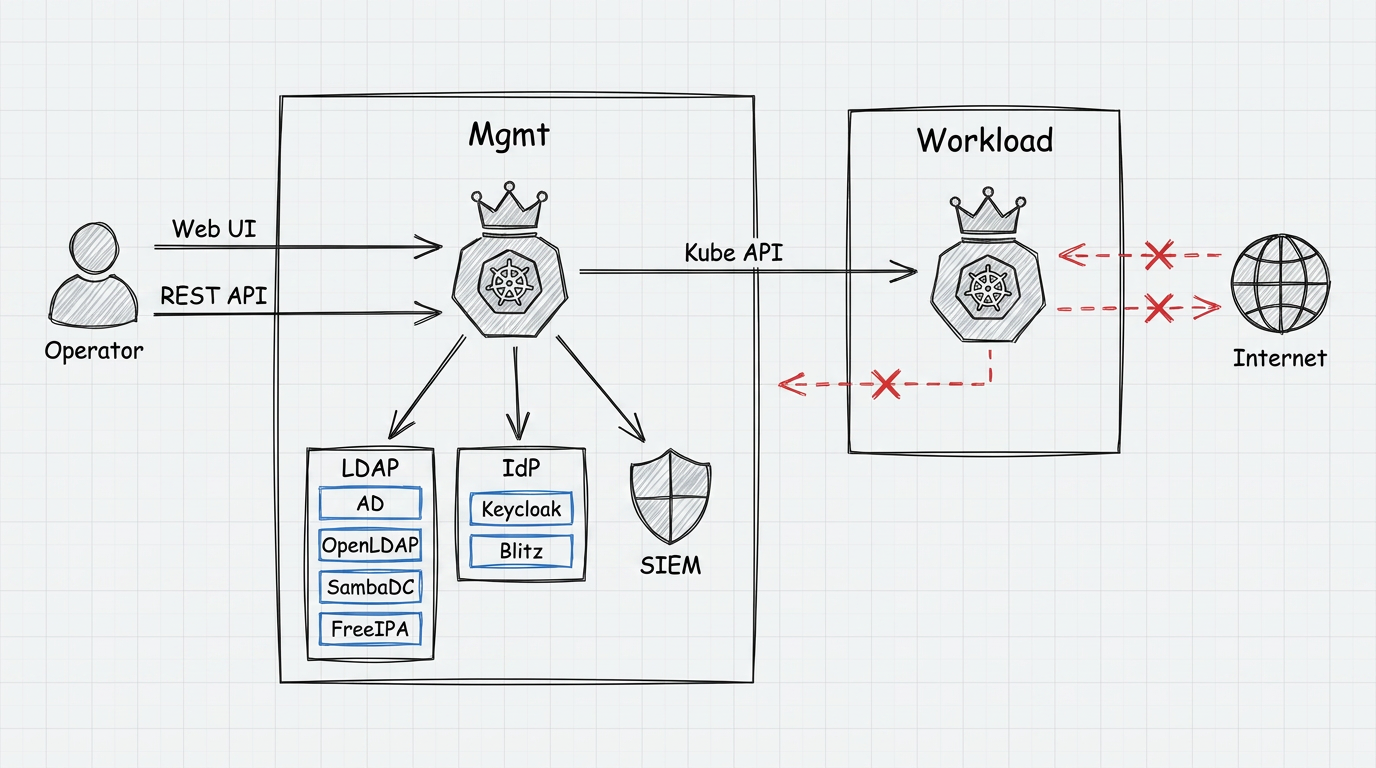
Operator (administrator) connects to the management cluster via Web UI or REST API. Management Cluster:
- Manages client clusters - through the Kube API creates, updates and controls resources (Cluster, Machine, MachineHealthCheck);
- Authenticates and Authorizes - integration with LDAP (AD, OpenLDAP, SambaDC, FreeIPA, MULTIDIRECTORY) and IdP (Keycloak, Blitz);
- Sends events to SIEM - data about security events to monitoring and audit systems.
Client clusters are managed by the management cluster via the Kube API. Rights are synchronized centrally; metrics and logs are collected in the management cluster in the Victoria Metrics cluster and displayedenjoy on Grafana dashboards. Client clusters are isolated from direct Internet access if necessary.
Function blocks and services
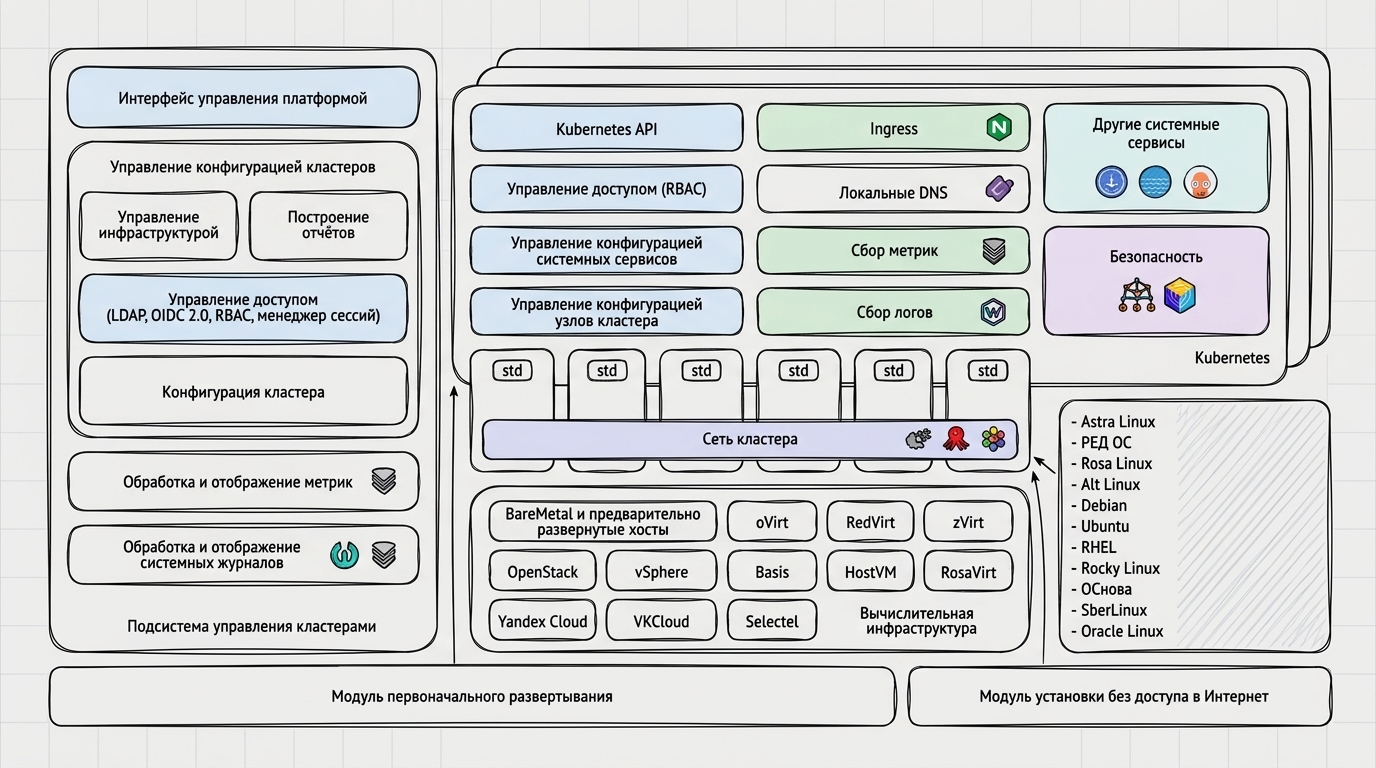
The core set of services is formed from the “Management Cluster Service” and critical services groups (“Shturval Repository Services”). Below are the functional blocks and corresponding services:
| Function block | Description | Services |
|---|---|---|
| Control Interface | GUI and API for working with clusters, services, nodes, repositories | shturval-frontend, shturval-backend |
| Access Control | LDAP, OIDC 2.0, RBAC, session manager | shturval-auth |
| Cluster Configuration Management | Infrastructure (providers, IP pools), reports on resources, image analysis, security policies | shturval-backend, shturval-cluster-manager |
| Configuration of clusters and nodes | Creation and configuration of client clusters, nodes, system services; scaling, MachineHealthCheck, Taints | shturval-capi, shturval-cluster-manager, shturval-node-config |
| Network and ingress traffic | CNI (Cilium), virtual IPs, Ingress, DNS cache | shturval-networking, shturval-ingress-controller, shturval-vip, shturval-vip-provider, shturval-caching-dns |
| Metrics | Collection, storage and visualization of metrics | shturval-monitoring, shturval-metrics-collector, shturval-dashboards, shturval-cert-expiration |
| Logging | Collection, aggregation and storage of logs | shturval-log-collector, VLogs |
| Storage and Snapshots | Local CSI storage, snapshots of critical data | shturval-local-csi, shturval-snapshotter |
| Backup | Backups of clusters and namespaces (Velero), basis for DR | shturval-backup |
| Orchestration of services | Installing and updating platform services | shturval-services, shturval-update |
| Certifications and Trust | TLS certificates, root CA | shturval-cert-manager, shturval-trust-manager |
More details: Cluster services, Access module architecture.
Modular platform on operators
The platform is built on Kubernetes operators and controllers. Management of functions (clusters, nodes, services, access, monitoring) is performed through custom resources (*.shturval.tech) and corresponding operators.
Some of the charts are our own development (shturval-cluster-manager, shturval-backend, shturval-frontend, shturval-auth, shturval-capov, shturval-node-config, shturval-services, shturval-update). The rest are collected from open-source with modifications for integration with the platform. More details: Safe assembly of platform components.
All system services and the Kubernetes version are updated every platform release. More details: Update Kubernetes in the Shturval platform.
Accommodation options
| Option | Description | When to use |
|---|---|---|
| On-premise | Management cluster on its own infrastructure (VMware vSphere, zVirt, oVirt, HostVM, RED Virtualization, ROSA Virtualization, bare metal) | Full control, data inside the perimeter |
| Cloud | Management cluster in public cloud (Yandex Cloud, VK Cloud, Selectel) | Deploy quickly, scale on demand |
| Hybrid | Management cluster in one environment, client ones in others (including bare metal via Shturval v2) | Separation of control and workload infrastructure |
System requirements for installation depend on the deployment type: open loop, closed loop.
Management cluster operating modes
| Mode | Description |
|---|---|
| Normal | The management cluster manages client clusters; workloads - in client clusters |
| Stand-alone | The management cluster is also used for workloads (without separate client clusters) |
| DR | Redundant management cluster for fault tolerance. More details: DR-config |
Supported infrastructure providers
Client clusters can be created based on:
- Shturval v2 - bare metal (physical hosts via SSH)
- oVirt, zVirt, HostVM, ED Virtualization, ROSA Virtualization
- VMware vSphere
- OpenStack, VK Cloud, Selectel
- Basis Dynamix
- VMware vCloud Director
- Yandex Cloud
For more details, see Infrastructure providers.